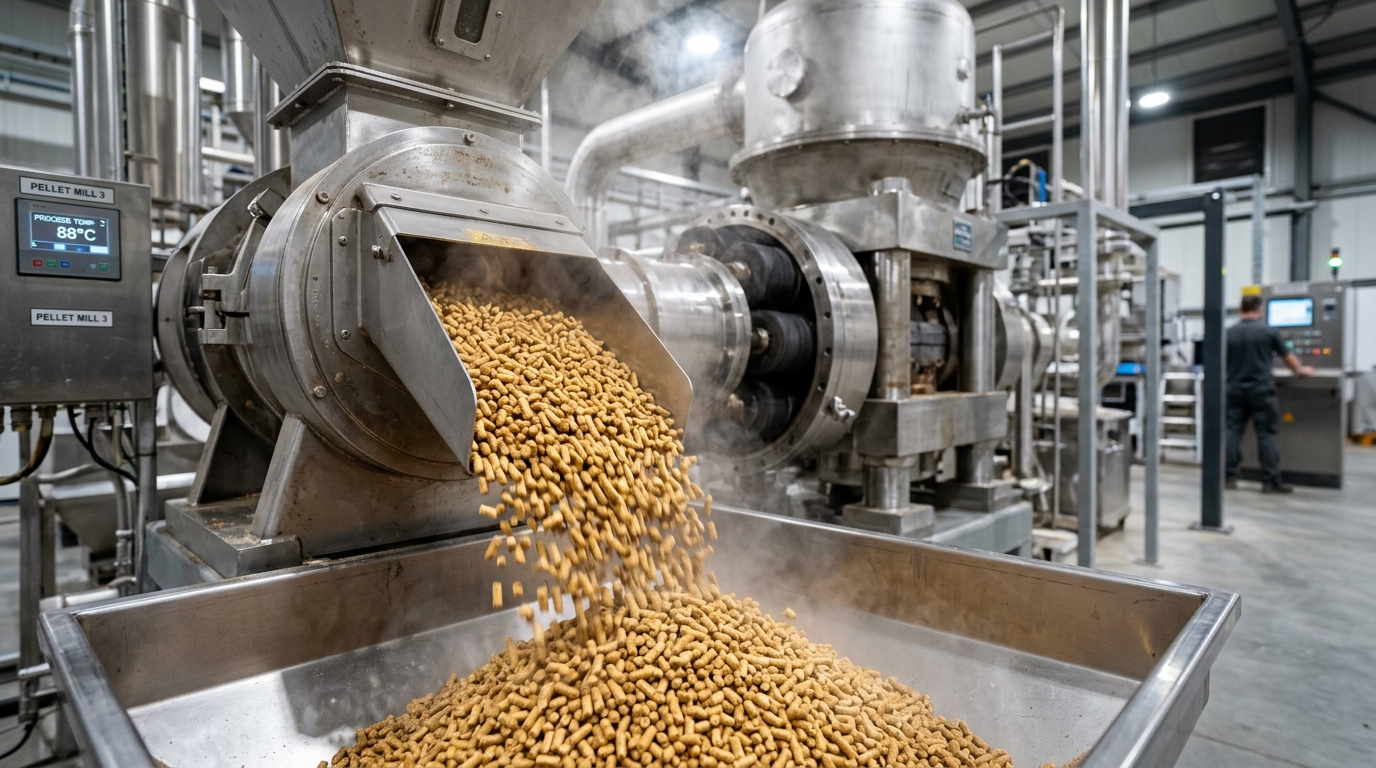
An applied industrial guide for feed millers correlating nutritional formulation matrices with physical pellet durability, conditioning steam, and die mechanics to minimize fines and energy consumption.
Beyond the Nutrient Sheet: When Quality Demands Physical Integrity
A feed formula may be mathematically flawless on paper, but if 25% of the pellets disintegrate into fines before reaching the farm's feed pans, bird performance and feed conversion collapse. Modern broilers and livestock do not consume laboratory spreadsheets; they consume physical feed particles. Optimizing the Pellet Durability Index (PDI)—the industry metric determining a pellet's ability to resist fragmentation during handling and transit—requires a deep convergence between nutritional chemistry and mechanical processing.
1. The Pellet Quality Factors: What Truly Governs PDI?
Extensive industrial milling research proves that pellet durability is governed by distinct operational pillars:
- Formulation Composition (40% Impact): Protein quality, starch gelatinization capacity, and fat inclusion.
- Conditioning & Steam Quality (20% Impact): Retention time, temperature (78°C - 88°C), and dry saturated steam pressure.
- Grinding Particle Size (20% Impact): Uniform geometric mean diameter (dgw 600 - 800 microns).
- Die Specifications & Compression (15% Impact): Die thickness-to-hole diameter ratio (L/D ratio).
- Cooling & Drying (5% Impact): Proper moisture removal to prevent sweating and mould growth.
2. The Starch Gelatinization vs. Fat Dilemma
Starch from wheat, corn, and barley acts as the primary natural binder in feed pellets. Under thermal moist conditioning, starch granules swell and gelatinize, creating a cohesive viscoelastic glue that binds feed particles together. Conversely, dietary fat acts as a potent lubricant. Adding more than 1.5% - 2.0% fat directly into the batch mixer coats starch granules, prevents steam penetration, and causes the PDI to collapse precipitously. To formulate ultra-high energy feeds (over 3150 kcal/kg ME) without sacrificing physical quality, enterprise mills rely on Post-Pellet Liquid Application (PPLA) systems, spraying the balance of vegetable oils after pellet cooling.
Key Engineering Targets for Modern Commercial Mills:
- Standard Holmen PDI: Greater than 92% - 95% after pneumatic stress simulation.
- Conditioner Retention Time: Minimum 45 to 60 seconds (extended up to 90s for pathogen reduction).
- Fines Return Rate: Less than 3% - 5% at the bagger or bulk load-out chute.
3. Protecting Heat-Sensitive Micro-Ingredients and Enzymes
As conditioner temperatures climb to 85°C+ to pasteurize salmonella and maximize PDI, heat-sensitive micro-nutrients face severe denaturation. Uncoated phytases, xylanases, and vitamin A/E complexes lose up to 40% - 60% of their bio-efficacy under high shear die friction. Formulators must collaborate closely with production managers to factor in thermal overages or specify thermotolerant, micro-encapsulated enzymes in the matrix.
4. Factoring Pelletability Indices Directly in Tawazon
Tawazon allows feed mill formulators to define physical processing constraints alongside traditional nutritional limits. By setting minimum starch gelatinization thresholds, restricting in-mixer fat, and incorporating pelletability scores into least-cost linear models, mills achieve high throughput, lower kilowatt-hour power draw at the press, and industry-leading pellet durability.